
If you need raw SEO data for your own report, spreadsheet, automation or AI workflow, DataForSEO is a strong fit when your usage is irregular and you can manage an API or no-code connector. The main tradeoff is that it gives you data rather than a finished SEO application, so you must assemble the workflow, interpretation and client-facing report.
DataForSEO uses prepaid credits instead of a normal monthly SEO subscription. The standard account requires a $50 minimum top-up, while new accounts receive a $1 trial credit for limited real API requests. Before paying, test representative requests in the Sandbox, API Playground or Google Sheets, then compare the returned fields with the report you plan to deliver. Prices checked November 11, 2026.
Key takeaways
- Choose DataForSEO for request-based SEO data, custom reporting and irregular usage.
- Choose a monthly SEO suite when you want dashboards, audits, reports and built-in interpretation.
- Start with the $1 trial credit, but budget for the regular $50 minimum top-up.
- Confirm the endpoint, billing unit, location, language, device and Live or Standard mode before estimating cost.
- Check redistribution rights, billing settings and any written SLA before using the data in a commercial product.
What DataForSEO is and who it fits
You are choosing between a data source you control and a finished SEO tool. DataForSEO is a pay-as-you-go SEO data API provider, not a conventional monthly dashboard such as Semrush or Ahrefs. Its v3 API uses REST and returns JSON by default, with XML and HTML formats also available.
That makes it a practical choice for a freelancer, agency, developer or technical business owner who wants to build a custom report, feed search data into an AI client, automate recurring checks or pay only when requests are made. The API covers rankings, keyword metrics, backlinks, crawling, local listings, shopping, app stores and AI visibility, so the same account can support several types of SEO work.
The tradeoff is the work that comes with flexibility. DataForSEO does not automatically create your dashboard, client report, workflow logic or business interpretation. You need to decide how many keywords, URLs, domains or SERPs to request, which fields matter, and how the result will reach the reader.
A monthly suite is usually a better fit when you want a ready-made interface, recurring reports, site audits and keyword tools without assembling the system yourself. DataForSEO fits better when usage changes from month to month, requests are made by software or automation, and you want control over the output.
Which SEO data the API families cover
Your first decision is the type of data your workflow needs. DataForSEO separates its coverage into API families, which lets you request a narrow result instead of paying for a complete SEO application.
The Keywords Data API covers Google Ads search volume, CPC, competition, keyword ideas, keywords for sites, keyword traffic, Google Trends, Bing Ads, DataForSEO Trends and clickstream-based search volume. Google Trends reports relative popularity, not absolute search volume, so it can show when interest rises without replacing a monthly search-volume figure.
DataForSEO Labs is aimed at research and market analysis. It supports keyword opportunities, related keywords, keyword difficulty, search intent, rankings, competitor domains, domain intersections, historical rankings, traffic estimates and market data from Google, Amazon, Google Play and the App Store. Amazon and Bing locations and languages are currently limited to US English in Labs, while Google supports broader combinations.
The Backlinks API provides backlink summaries, individual backlinks, referring domains, anchor text, competitor comparisons, domain and page intersections, link history, new and lost links, spam scores and bulk metrics. Its coverage comes from DataForSEO’s own continuously crawled index, so it should not be treated as a universal record of every link on the web.
For technical work, the On-Page API crawls websites and reports page checks, duplicate titles and content, resources, redirects, internal and external links, non-indexable pages, waterfalls, keyword density, raw HTML and screenshots. JavaScript and browser-rendering options are available for pages that need more than a basic request. Lighthouse scans are billed separately.
The Domain Analytics API supplies WHOIS records, domain metrics and detected technologies. The Content Analysis API reports citations for a keyword or brand, sentiment polarity, sentiment connotations, ratings and citation trends.
DataForSEO also has newer data categories. The AI Optimization API covers LLM responses, scraped LLM answers, AI keyword demand and brand or website mentions in LLM outputs. The Business Data API covers Google Business Profile information and updates, Google reviews, Google Hotels, Trustpilot, Tripadvisor and other business listings. The Merchant API covers Google Shopping and Amazon product listings, sellers, prices, product specifications, ASINs and related marketplace data. The App Data API covers Google Play and App Store rankings, app information, ratings, reviews, listings and collections.
Location and language settings matter. For Spanish-language work, use language_code: es with the intended country or local location, such as the United States, Mexico, Chile, Costa Rica, El Salvador, Panama, Paraguay, Peru, Uruguay or Venezuela. Exact combinations vary by endpoint. Bing, Yahoo and Baidu also have their own location and language rules, and Naver does not use those parameters in the same way.
How fresh and reliable the data is
You need to match the data’s update pattern to the decision you are making. DataForSEO’s Backlinks API uses a continuously crawled live index, while Google Ads data follows Google’s update cycle, generally around the middle of the month. Bing data may take up to 72 hours after the previous calendar month.
Database SERPs and listings are updated gradually over 60 to 90 days. Keyword databases are updated gradually around the second part of each month. That timing can be suitable for broad research, but it may not match a workflow that needs a fresh result for every request.
Standard results are normally stored for 30 days, HTML results for seven days, and Live results are generally not stored. Live requests can return immediately through one call, while Standard or queued requests usually cost less and return later.
DataForSEO claims 99.95% uptime and advertises 24/7 live-chat support. Its status endpoint exposes current endpoint conditions and up to 60 days of status information. Treat the uptime number as a provider claim, and assess reliability by the endpoint, mode and result type your workflow actually uses.
User reports are mixed. Capterra and G2 reviews praise documentation, technical support, breadth and pay-as-you-go billing, while other reviews mention geographic differences in accuracy, occasional slowness, a dated interface and search-volume discrepancies. These reports describe individual experiences, not a guaranteed result for every account.
What happened when we opened an account
Before you read the price table, it helps to know what the first hour looks like. We opened an account on November 11, 2026. Signup asks for a name, email and password, then a two-step survey about how you plan to use the API (up to three uses, an integration method, your role and when you plan to start). It is quick, and you can pick "No-code" if you are not building software.
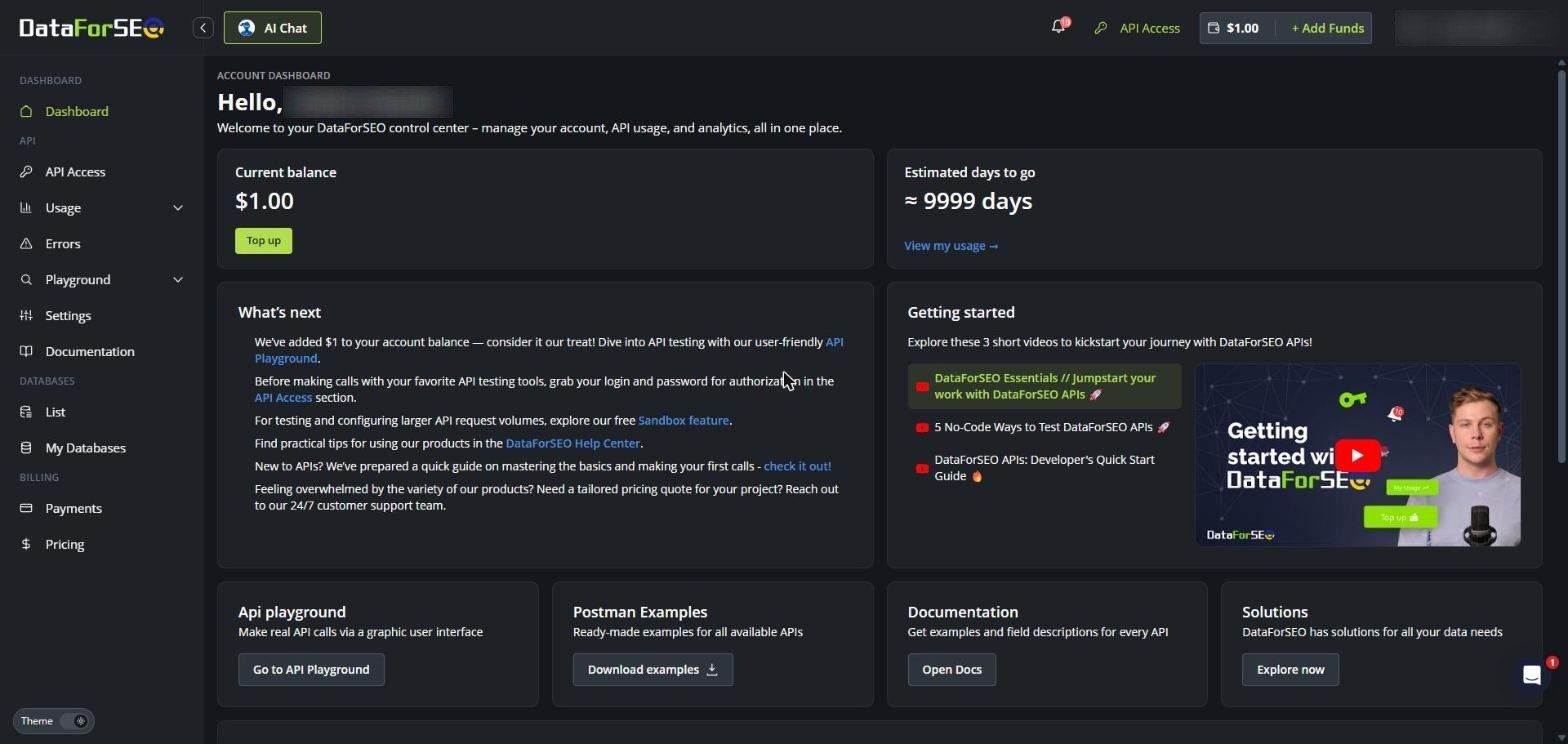
DataForSEO then sends an activation email, which arrived about a minute after signup. The account is not usable until you click "Activate account" in that message, so check your inbox and spam folder before you go looking for the dashboard. Once activated, the dashboard showed a $1.00 trial balance. A welcome email also mentions an "unlimited free trial" for the APIs, but the dashboard credit is the figure that matters: it is $1, and real requests spend it.
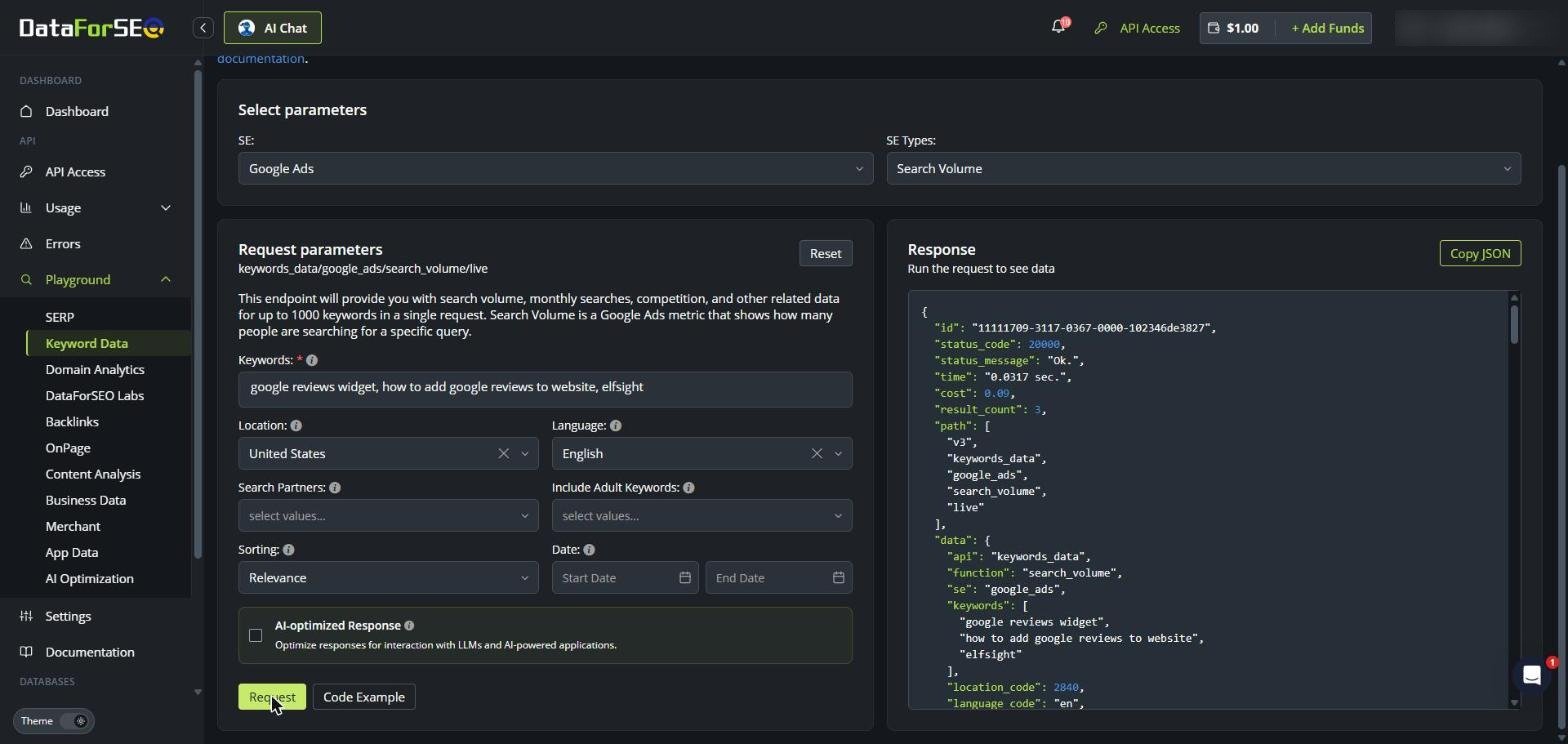
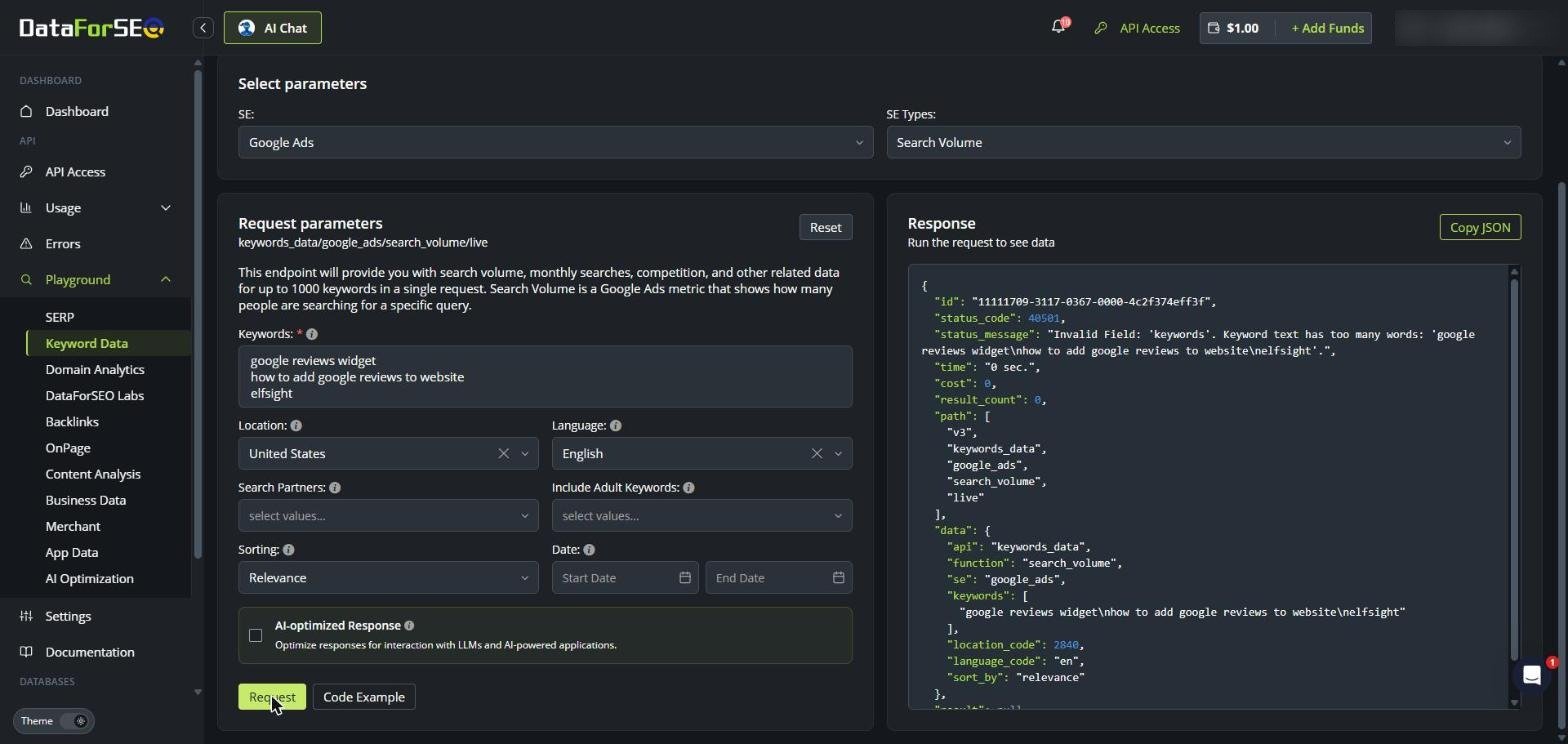
Prices in this section were checked November 11, 2026. Our first request was a Keyword Data lookup in the API Playground for three keywords in the United States. One mistake is worth avoiding: we typed one keyword per line and the request failed with error 40501, "Keyword text has too many words", because the lines were read as a single keyword. Separate keywords with commas. The failed request cost nothing. The corrected request returned all three keywords and cost $0.09, which is the price of the whole task rather than of each keyword, so batch your keywords instead of sending them one at a time.
When the trial balance runs low, the minimum top-up is $50, and the checkout is run by Paddle. Our $50 top-up cost $53.30 once Paddle added sales tax, so budget a little over $50. The card statement line reads PADDLE.NET* DATAFORSEO, and a Paddle receipt email follows, so keep it for your expense records. Auto-recharge was off by default; leave it off until you know your monthly spend.
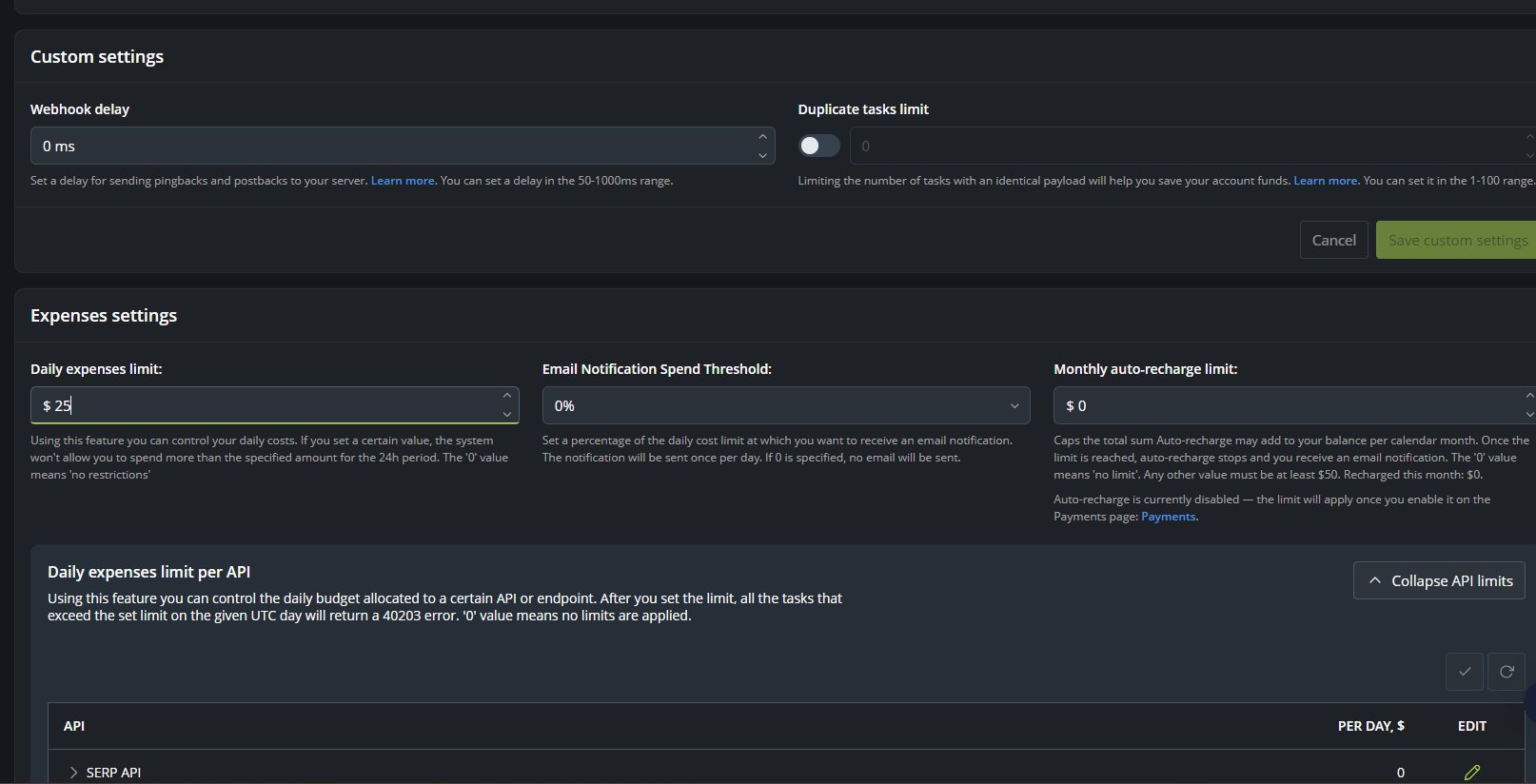
Two settings are worth a minute before you connect any software. The daily spending limit defaults to $1,000, and we lowered ours to $25 under Settings. Expect marketing email after signup too, because we were added to the newsletter list. Use the unsubscribe link in the email footer if you only want account and billing mail.
What DataForSEO costs in practice
You are not buying a monthly plan with a normal renewal price. DataForSEO deducts request charges from a prepaid balance, and unused ordinary API credits do not expire each month. The regular account commitment is the $50 minimum top-up. New accounts receive a $1 trial credit, but that credit supports only a limited number of real API calls. The Sandbox provides generated sample responses without using the same test process as a live workflow.
The following published rates were checked November 11, 2026. They are request prices, not monthly plans.
A few examples show how the arithmetic changes with volume. One Labs task returning 1,000 items costs $0.012 plus $0.12, for $0.132. One Backlinks task returning 1,000 rows costs $0.024 plus $0.036, for $0.06. Ten thousand basic On-Page crawled pages cost $1.50 before any separate scan or endpoint conditions.
Standard or queued requests generally cost less than Live requests. Some APIs use Normal and High priority queues, so the exact endpoint page matters. Check the endpoint’s current price, billing unit and processing mode immediately before budgeting a workflow. A task may bill by request, returned item, crawled page, citation row or result page.
The provider lists credit cards, debit cards, PayPal and Amazon Pay. Wire transfer and ACH are available for payments of $5,000 or more. Auto-recharge can be enabled with a balance threshold and recharge amount, so confirm the account’s billing mode and disable auto-recharge if you do not want a new charge.
The terms provide a 30-day no-question refund for first-time API-credit purchases. Database purchases are excluded, and customer-side errors such as duplicate or improperly submitted tasks are not refundable. For endpoint-level examples and monthly scenarios, use DataForSEO Pricing: What Each API Costs Per Request, With Real Monthly Examples.
How to use DataForSEO without building everything from scratch
You can start with a small workflow instead of writing a full application. The dashboard includes an API Playground with a graphical interface. It makes actual API calls, so those calls charge the account rather than acting as cost-free previews.
The official Google Sheets connector supports keyword suggestions, search performance, On-Page audits and backlink lookups. It requires a DataForSEO account, API credentials, the Sheets extension and a copied template. After the returned fields match your intended report, confirm that the reporting tool accepts the resulting data format.
DataForSEO also documents integrations or templates for n8n, Make, Airtable, Postman, Zapier, Pabbly and Lindy.ai. These tools can pass requests between forms, spreadsheets, databases and reports, but the API balance still pays for the underlying requests.
An MCP server connects DataForSEO with compatible AI clients such as Claude, ChatGPT, Cursor and Codex. The AI client can help form requests or interpret results, but MCP does not make the API free and does not remove the need to protect credentials. If that is your preferred route, follow DataForSEO MCP: How to Connect It to Claude, Claude Code and ChatGPT, and What It Costs.
The limits, terms and compliance tradeoffs
Your workflow needs more than a price estimate. It also needs a clear answer about what you may store, show and resell. DataForSEO’s standard terms do not automatically grant rights to redistribute raw datasets, expose a raw public endpoint, sell a database dump or provide raw API access as a standalone service. A separate written agreement is required for that type of use.
You remain responsible for complying with Google, Bing and other upstream platform terms. Keyword APIs can restrict categories such as weapons, tobacco, drugs, violence and terrorism. One restricted keyword can prevent a submitted batch from returning data, so filter inputs before sending large tasks.
Rate limits vary by API. DataForSEO Labs allows up to 10,000 calls per minute with a maximum of 30 simultaneous requests. Your own endpoint may have different limits, and Live access is not automatically available for every API.
The retention period also changes by mode. Standard results are normally retained for 30 days, HTML results for seven days and Live results are generally not stored. Wider account and personal-data retention is governed separately by the provider’s privacy documents, so ask DataForSEO which processing regions apply to the intended API and data category before procurement.
The terms allow suspension or refusal of service and disclaim liability for downtime, crashes and data loss. DataForSEO advertises a status endpoint and 24/7 live chat, but a support channel is not the same as a written service-level agreement. Confirm any SLA, service credit or high-volume arrangement in writing before relying on it.
DataForSEO’s migration guide states that v2 stopped being supported on May 5, 2026. New integrations should use v3. There is also no hosting-style migration service to assess. Moving an integration means moving credentials, request logic, stored outputs and reporting workflows.
DataForSEO compared with a SERP API or monthly SEO suite
Choose a focused SERP API when your main requirement is search-result access and you do not need the wider keyword, backlink, crawling, listing, shopping, app or AI families. SerpApi is a natural comparison for that use case. Compare the exact endpoint, output fields, location coverage, limits and total workflow cost for your intended volume. The DataForSEO vs SerpApi vs Serper comparison can help with that decision.
Choose a monthly SEO suite when you want dashboards, site audits, keyword tools, rank tracking, reports and built-in interpretation in one interface. Semrush and Ahrefs are better suited to a team that values a finished product over request-level control. Their commercial models and included limits differ from DataForSEO’s prepaid billing, which starts from a $50 minimum top-up, checked November 11, 2026.
DataForSEO is the better conditional pick when usage is irregular, the buyer can manage an API or connector, and the workflow needs individual requests. A monthly suite is the safer fit when the buyer needs recurring client reporting without maintaining request logic. For the broader product decision, compare DataForSEO vs Semrush vs Ahrefs: Pay-Per-Request Data or a Monthly SEO Tool.
Frequently asked questions
Is DataForSEO good?
DataForSEO is good for developers, freelancers and agencies that need individual SEO data requests, custom reports or irregular usage. It is less suitable when you want a finished dashboard with built-in reporting and interpretation.
Is DataForSEO reliable?
DataForSEO claims 99.95% uptime and provides a status API for endpoint conditions. Reliability still depends on the endpoint, processing mode, rate limits and data source used by your workflow.
How accurate is DataForSEO?
Accuracy depends on location, language, device, search engine and data source. User reports describe both adequate results and discrepancies, especially in search-volume data, so compare representative responses with the report you plan to produce.
What does DataForSEO do?
DataForSEO supplies structured data for search results, keyword metrics, competitor research, backlinks, website crawling, domains, content citations, AI mentions, business listings, shopping results and app stores. It returns that data through APIs and related connectors.
Is DataForSEO free?
New accounts receive a $1 trial credit, and the Sandbox supplies sample responses. The credit supports a limited number of real API requests, while the ordinary account requires a $50 minimum top-up. Prices checked November 11, 2026.
Is DataForSEO a monthly subscription?
Standard API access uses prepaid balance rather than a conventional monthly subscription. Auto-recharge is optional, but you should confirm the account’s billing mode because elected subscription or billing terms can contain automatic-renewal language.
Is DataForSEO down?
A general website problem does not prove that every API endpoint is unavailable. Use DataForSEO’s API status endpoint, check the endpoint state and review the returned task status or error response.
Can you redistribute DataForSEO data?
Not automatically under the standard terms. Raw datasets, raw API access and standalone public feeds require separate written permission or an agreement that grants those rights.
What are some good alternatives to DataForSEO?
SerpApi is a focused alternative for search-result API access. Semrush and Ahrefs are alternatives when you want a finished SEO suite with dashboards, site audits, keyword tools, rank tracking and reports.
If your test confirms that request-based data fits, set spending limits and use the connector or API that matches your reporting process. If the setup feels like too much maintenance, choose a monthly suite and compare its full commitment, limits and renewal terms before paying.
Glossary
Find more reviews and guides on Even Reviews. Spotted something to correct? Contact us and include the page title.